Thailand’s New Sealed-Container Food Rules Take Effect June 19, 2026
Thailand’s Ministry of Public Health Notification No. 469 entered into force on May 19, 2026, introducing mandatory technical requirements for all sealed-container foods—including canned and bottled shelf-stable prepackaged products—imported into or domestically produced in Thailand. The regulation directly impacts Chinese exporters of meat canned goods, ready-to-eat sauces, and prepared soups, requiring revalidation of thermal processing protocols and updated compliance documentation ahead of customs clearance.
Event Overview
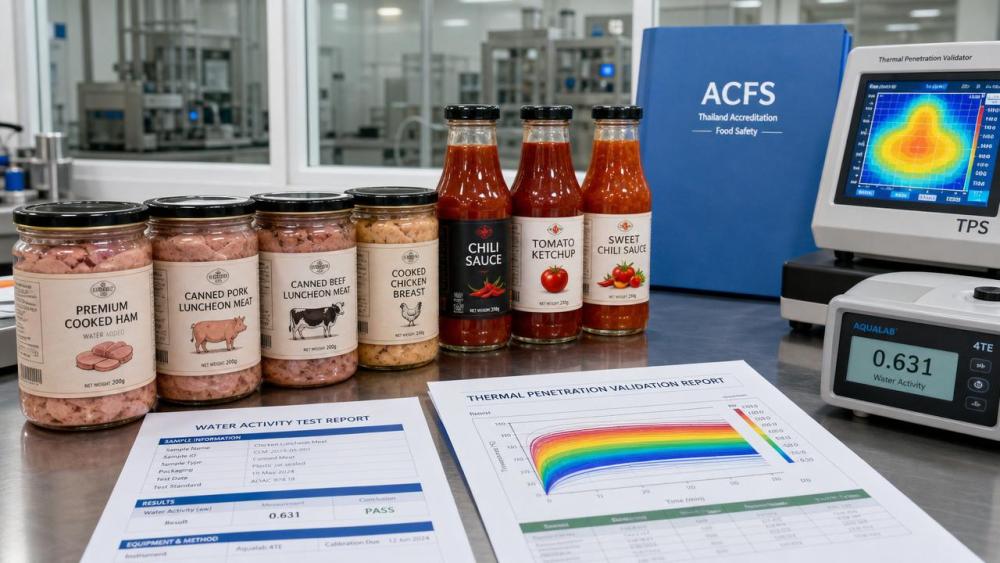
Thailand’s Ministry of Public Health Notification No. 469 officially took effect on May 19, 2026. It mandates full-chain technical standards for all sealed-container foods (e.g., canned and bottled shelf-stable prepackaged foods), including water activity testing, thermal sterilization validation, Clostridium botulinum control, and heat distribution/heat penetration studies. The Thai Agricultural Commodities and Food Standards Authority (ACFS) is the implementing regulatory body.
Industries Affected by Segment
Direct Exporters to Thailand
Exporters shipping canned or bottled food products to Thailand must now meet revised process validation and analytical testing requirements before shipment. Impact manifests in delayed customs clearance, increased pre-shipment testing costs, and potential rejection if documentation lacks validated thermal process data or fails to demonstrate C. botulinum control.
Food Manufacturers (Canned & Bottled Products)
Domestic producers supplying export-oriented brands face new obligations to revalidate thermal processing parameters—not only for new products but also for existing SKUs intended for the Thai market. This includes updating process authority letters, retort mapping reports, and microbiological challenge studies aligned with ACFS criteria.
Third-Party Testing & Certification Providers
Laboratories and certification bodies supporting Chinese exporters must verify whether their current test scope covers ACFS-mandated parameters—particularly heat distribution/penetration testing and water activity measurement under specified conditions. Gaps may require method validation or accreditation extension prior to issuing accepted reports.
Supply Chain & Logistics Service Providers
Firms managing documentation for Thai-bound consignments must now integrate new technical annexes—such as thermal process validation summaries and C. botulinum risk assessments—into standard commercial invoices, certificates of origin, and health certificates. Incomplete submissions risk hold-ups at Thai ports.
Key Focus Areas and Recommended Actions
Monitor Official ACFS Guidance and Interpretive Updates
While Notification No. 469 is in force, ACFS has not yet published detailed implementation guidelines or acceptable methodologies for heat penetration testing or C. botulinum challenge protocols. Exporters should track ACFS bulletins and consult Thai importers for early insights on document acceptance practices.
Prioritize Review of High-Risk Product Categories
Products with low-acid formulations (e.g., meat-based canned goods, vegetable-based soups, oil-infused sauces) are most likely to trigger scrutiny under the new rules. Firms should begin revalidating thermal processes for these categories first—especially where historical process data lacks retort mapping or cold-spot identification.
Distinguish Regulatory Signal from Operational Readiness
The rule’s effective date (May 19, 2026) marks formal adoption—not necessarily immediate enforcement across all Thai ports. However, customs officers may request supporting documentation on a case-by-case basis. Firms should treat this as a signal to align internal systems, not wait for enforcement patterns to emerge.
Prepare Documentation and Communication Protocols Early
Update internal SOPs for Thai-bound shipments to include verification steps for water activity reporting, thermal process authority sign-off, and third-party lab report formatting. Proactively engage Thai importers to confirm acceptable file formats, language requirements (e.g., English vs. Thai translation), and lead time expectations for document review.
Editorial Perspective / Industry Observation
Observably, this regulation reflects Thailand’s broader shift toward harmonizing domestic food safety oversight with Codex Alimentarius principles—particularly for low-acid, thermally processed foods vulnerable to C. botulinum. Analysis shows it functions less as an immediate trade barrier and more as a structural recalibration: it elevates baseline technical expectations for market access, making prior process validation—not just end-product testing—a prerequisite. From an industry perspective, the timing suggests increasing emphasis on traceability of thermal lethality data rather than reactive compliance. Current attention should focus on how ACFS interprets ‘validation’ for legacy production lines and whether transitional allowances apply to existing registrations.
In summary, Thailand’s new sealed-container food regulation signals a tightening of technical entry requirements—not a sudden restriction. Its practical impact hinges on documentation rigor and process transparency, not product reformulation. For affected exporters, it is best understood as a procedural upgrade to market access, demanding proactive alignment with ACFS’s evolving technical expectations rather than reactive correction.
Source: Thailand Ministry of Public Health Notification No. 469 (effective May 19, 2026); Thai Agricultural Commodities and Food Standards Authority (ACFS) public notice archive. Note: Detailed implementation guidance, acceptable test methods, and transitional provisions remain pending official publication and are subject to ongoing monitoring.
Related News
 How Freeze Drying Technology for Coffee Preserves Aroma and Improves Shelf LifeDiscover how freeze drying technology for coffee preserves aroma, improves shelf life, and supports premium quality with smart processing and packaging insights.
 FDA Sets CIP/SIP Flow Validation Rule for 2026FDA Sets CIP/SIP Flow Validation Rule for 2026: learn how the new FDA update impacts food equipment exports, EHEDG 42:2025 compliance, supplier audits, and U.S. market readiness.
 How to Choose Stainless Steel Deboning Equipment for Throughput, Hygiene, and YieldStainless steel deboning equipment buying guide: learn how to balance throughput, hygiene, and yield to cut downtime, protect food safety, and improve processing profits.
 EU Tightens MAP Gas Certification From October 2026EU Tightens MAP Gas Certification From October 2026: learn how EN 14185-2:2026, traceable batch data, and stability reports will impact MAP suppliers, importers, and market access.
 Vacuum Freeze Drying for Probiotics: Process Basics, Benefits, and Key LimitsVacuum freeze drying for probiotics explained: learn process basics, key benefits, major limits, and how to evaluate viability, cost, packaging, and scale-up before choosing this method.
 FDA Expands 3A Mutual Recognition for Food Machinery SealsFDA expands 3A mutual recognition for food machinery seals, reshaping U.S. compliance for sanitary equipment. Learn the impact on exporters, buyers, and certification workflows.
 How to Evaluate a Bottle Filling Equipment Manufacturer for Accuracy, Hygiene, and ThroughputBottle filling equipment manufacturer selection starts with proven accuracy, hygienic design, and sustainable throughput. Learn what to verify before you buy with this practical guide.
 EU Rule Sets MAP Sensor Requirement for ImportsEU Rule Sets MAP Sensor Requirement for Imports: learn how the new EU MAP equipment rule impacts CE compliance, validation data, delivery timelines, and supplier readiness before August 1, 2026.
 Commercial Food Processing Hygiene Checklist for Audits, Zoning and Allergen ControlCommercial food processing hygiene checklist for audits, zoning, and allergen control. Learn practical steps to improve compliance, reduce risk, and strengthen plant performance.
 High Efficiency Food Manufacturing: Where Throughput Gains Offset Equipment CostHigh efficiency food manufacturing turns equipment cost into margin through higher throughput, lower waste, better hygiene, and longer shelf life. See what drives faster ROI.
 Dough Processing Machinery for Pizza: What to Compare Before Choosing a LineDough processing machinery for pizza: compare dough handling, sanitation, throughput, flexibility, and operating cost before choosing a line that protects quality and boosts ROI.
 Energy Efficient Vacuum Drying: Key Parameters, Limits and Best-Fit MaterialsEnergy efficient vacuum drying explained: learn the key parameters, practical limits, and best-fit materials to improve product quality, sanitation, and operating efficiency.